
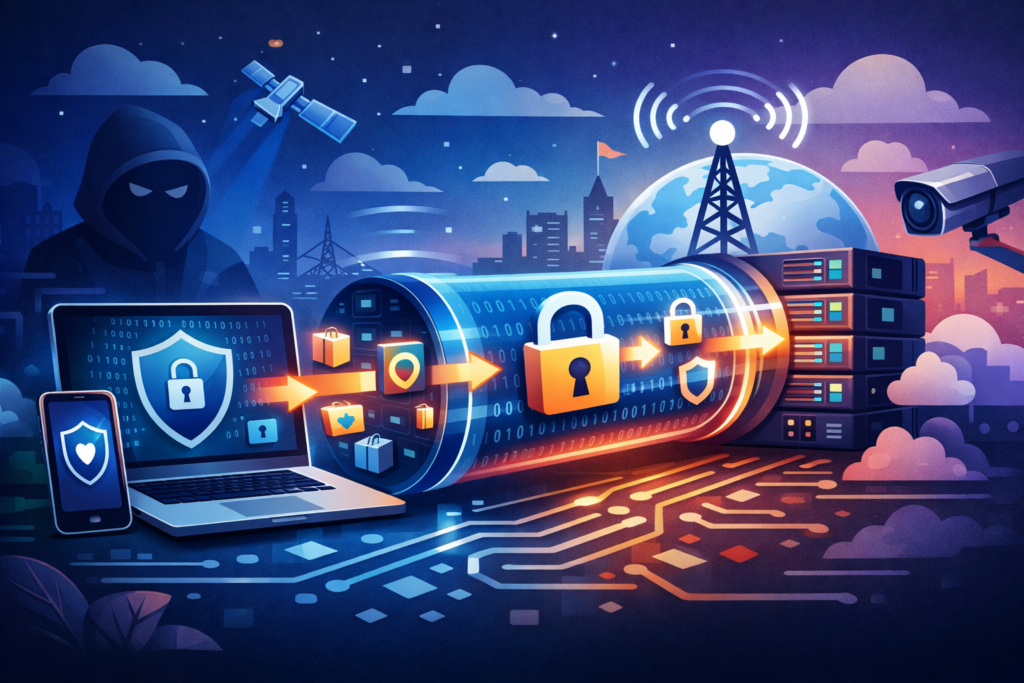
When you connect to a public Wi-Fi network at an airport or café, your internet traffic does not travel directly from your device to the website you are visiting. It passes through routers, network operators, and internet service providers. A free VPN changes that path by adding a secure layer between you and the wider internet.
Instead of sending your data in plain form, a VPN encrypts it and routes it through a remote server. Anyone trying to intercept your traffic—whether it’s a malicious actor on the same network or an ISP monitoring traffic patterns—sees only unreadable data.
Understanding how this process works helps you evaluate what a VPN can realistically protect and where its limits are.
What a VPN Actually Does
A Virtual Private Network (VPN) creates a secure connection between your device and a remote server. From a technical perspective, it performs two essential tasks:
- Encrypting your data before it leaves your device
- Masking your IP address by routing traffic through a VPN server
Encryption ensures that even if someone captures your data packets, they cannot read their contents without the correct cryptographic key. IP masking prevents websites and online services from directly identifying your real network location.
VPNs are used for several practical reasons:
- Protecting sensitive activity on unsecured networks
- Reducing ISP visibility into browsing behavior
- Accessing services from different geographic regions
- Maintaining a degree of online anonymity
The effectiveness of these protections depends largely on the technology working in the background.
The Core Technology: Encryption Explained
Encryption is the foundation of any VPN service. It transforms readable information (plaintext) into unreadable code (ciphertext). Only someone with the correct decryption key can convert it back into its original form.
There are two primary types of encryption involved in VPN technology:
Symmetric Encryption
This method uses a single key for both encryption and decryption. It is fast and efficient, making it suitable for transferring large volumes of data.
Asymmetric Encryption
This method uses two keys: a public key for encryption and a private key for decryption. It is commonly used during the initial handshake between your device and the VPN server to securely exchange session keys.
Most modern VPNs combine both methods: asymmetric encryption to establish a secure connection, and symmetric encryption to handle ongoing data transmission.
Encryption Protocols Used by VPNs
Encryption does not work alone. It operates within protocols that define how data is transmitted securely. Common protocols include:
- OpenVPN – Open-source, flexible, and widely audited
- WireGuard – Lightweight and performance-oriented
- IKEv2/IPSec – Stable and well-suited for mobile connections
Each protocol balances speed, compatibility, and security differently. A well-designed VPN service selects protocols based on platform requirements and user needs rather than marketing claims.
The strength of encryption also depends on cryptographic key length. Longer keys are significantly more resistant to brute-force attacks, which attempt to guess the key through repeated trials.
How a Free VPN Protects Your Data in Practice
When you activate a VPN, several processes occur almost instantly:
- Your device authenticates with the VPN server.
- Encryption keys are securely exchanged.
- An encrypted tunnel is created.
- All outgoing and incoming traffic flows through this tunnel.
This encrypted tunnel prevents third parties from reading your data—even if they intercept it.
Protection Against ISP Monitoring
Internet Service Providers can normally see which domains you access and how much data you transmit. With encryption in place, they can detect that you are connected to a VPN server, but they cannot inspect the content of your traffic.
Security on Public Wi-Fi
Public networks are especially vulnerable because attackers can set up rogue access points or intercept unencrypted traffic. A VPN reduces this risk by encrypting data before it reaches the network.
This does not eliminate all online threats, but it significantly lowers exposure to passive surveillance and data interception.

The Role of Tunneling Protocols
Tunneling protocols define how encrypted data is packaged and transmitted. Think of tunneling as placing your encrypted data inside another secure container before sending it across the internet.
Different tunneling protocols affect:
- Connection stability
- Data transfer speed
- Compatibility with devices
- Resistance to network filtering
For example, some protocols prioritize performance for streaming and large downloads, while others focus on maximum encryption strength.
Choosing the right protocol is often automatic in modern VPN applications, but understanding their function clarifies how secure connections are maintained.
User Experience and Accessibility
Technical strength alone does not determine whether a VPN is practical for daily use. Installation simplicity, interface clarity, and cross-platform compatibility all matter.
A well-designed VPN application typically offers:
- One-click connection
- Clear server location selection
- Minimal configuration requirements
- Transparent privacy documentation
For mobile users, ease of access becomes even more important. On Android devices, you can download a free VPN directly from Google Play, allowing quick setup and secure browsing on the go.
iPhone and iPad users can access a free VPN from the App Store with similar simplicity, ensuring encrypted connections across iOS devices.
Cross-platform support ensures that encryption technology is not limited to desktop environments but extends to everyday mobile usage.
Risks and Realistic Expectations
Not all free VPN services operate under the same standards. Before using any VPN, consider:
- Whether it clearly explains its privacy policy
- If it specifies logging practices
- Whether encryption standards are documented
- If the application receives regular updates
A transparent privacy policy and clearly stated no-logs approach reduce uncertainty. At the same time, users should recognize that no VPN can guarantee total anonymity. Encryption protects data in transit, but it does not replace safe browsing habits.
Is a Free VPN Enough for You?
The answer depends on your needs. For everyday activities such as browsing on public Wi-Fi, adding encryption to your connection provides meaningful protection. It prevents casual monitoring and shields sensitive data from being easily intercepted.
If your primary concern is adding a basic security layer to your internet connection without cost barriers, a free VPN can serve that role effectively.
The key is understanding what happens behind the “Connect” button. Encryption, tunneling protocols, and secure key exchange mechanisms work together to form the backbone of VPN technology. When you know how these systems function, you can evaluate VPN services based on technical merit rather than marketing claims.
Online privacy is not about invisibility; it is about control. A VPN gives you an additional layer of that control—especially when encryption is implemented transparently and responsibly.
More Stories
Win777 Vegas X Guide: Web Version, Domain Confusion and App Access
Top 3 AI Voice Agents for Businesses in 2026
Interactive Spins: How Technology Is Modernizing Slot Games
YES2WIN Malaysia: Explore Casino Games, Promotions and Player Rewards